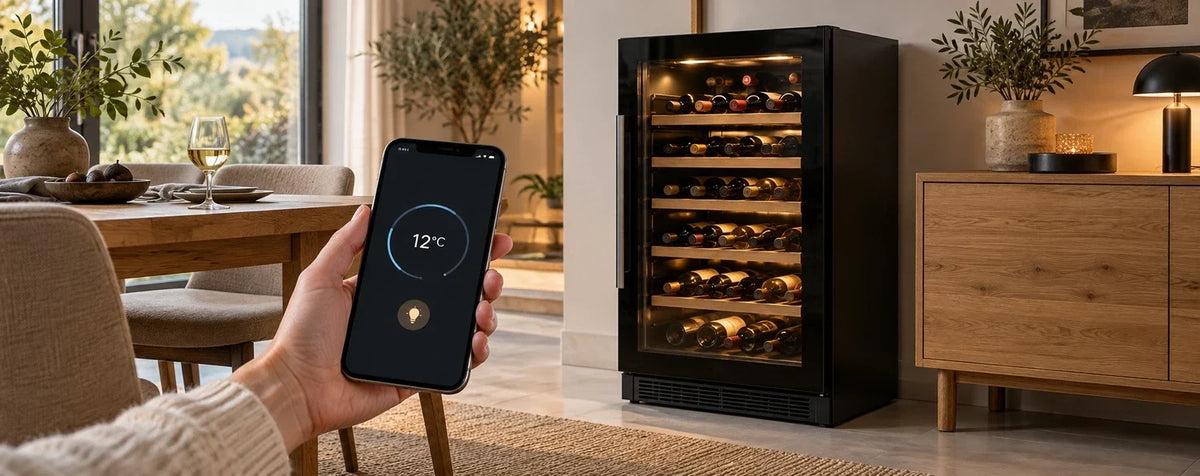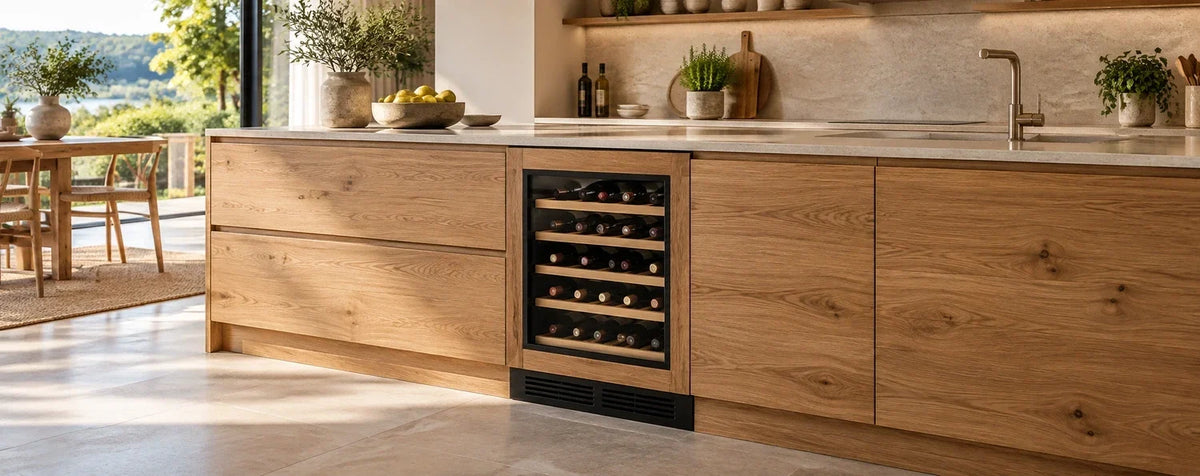
A wine cooler with a furniture front is designed to accept a compatible cabinet panel or decorative frame on its door. This version is often called Panel Ready. Before planning your kitchen, check model approval, the opening, panel, ventilation and door clearance together. A built-in appliance is not automatically suitable for a furniture front.
A kitchen feels calm when materials, joints and proportions work together. A panel-ready wine cooler can become part of that design: your wine has a dedicated home, while the front coordinates with the cabinetry. Involve your kitchen planner early, before the cabinets are ordered.
What does Panel Ready mean for a wine cooler?
Panel Ready describes the intended mounting of a decorative front on the appliance. Depending on its construction, this may be a solid cabinet panel or a frame that leaves the glass door visible. The permitted design comes from the instructions for the exact model. The term furniture front therefore does not mean that any glass door can be completely covered with wood.
For mQuvée WineCave 780 60D Panel Ready, the product information describes adapting the door frame with your own front. WineKeeper Exclusive 25D Panel Ready Push-Pull is another Panel Ready version in the range. These examples show why the appliance format and installation position matter alongside its appearance.
Furniture front, built-in and undercounter: three different specifications
| Term | What it describes | What else to check |
|---|---|---|
| Undercounter | Intended installation beneath a worktop. | Opening dimensions, plinth and airflow in the installation drawing. |
| Built-in / integrated | Intended installation in cabinetry, such as a tall unit. | Approval for the intended position and ventilation layout. |
| Panel Ready / furniture front | Intended mounting of a compatible decorative front. | Panel dimensions, weight, fixings and opening system. |
An appliance can combine several of these properties. A freestanding wine cooler, however, should not simply be placed in a closed cabinet opening. For an initial overview, read our comparison of built-in and undercounter wine coolers.
1. Choose the exact model first
Confirm the full model designation, including the Panel Ready version, before your kitchen studio orders the furniture. A similar model number or the same product family does not replace mounting approval. Include the current installation drawing, panel drawing and mounting instructions in the plan.
Also clarify what is supplied: is a fixing kit included? Who makes the furniture frame? Does the kitchen manufacturer need to supply the panel separately? Who installs and aligns the appliance? These questions affect both work and total cost, even when the appliance price is already known.
2. Measure the opening, worktop and plinth together
Record the clear width, height and depth of the opening. Allow for the finished floor level, worktop underside, adjustable feet and socket position. Appliance dimensions are not automatically the required opening dimensions: connections, airflow and fitting clearance may need additional space.
In a German fitted kitchen, front height and plinth proportions deserve particular attention. A stated door height of 780 mm does not define the appliance height or prove compatibility with a kitchen range. Likewise, a nominal 60 cm opening does not guarantee that every similarly described appliance will fit. Compare the drawings in millimetres.
A higher or lower plinth changes the visible proportions. Check that the top edge of the appliance front, joints and neighbouring cabinet doors will align after installation.
3. Have the furniture front made to the drawing
- Front width and height, including any glass opening.
- Permitted material thickness and panel weight.
- Drilling pattern, screws and approved fixing points.
- Clearances to neighbouring fronts and the worktop.
- A suitable handle or an explicitly compatible handle-free opening system.
A heavy panel places different demands on the door system from a light frame. Do not choose your own weight limits or attach fixings to the glass. Your kitchen studio should manufacture the panel using the selected model’s instructions and coordinate fitting with the responsible installer. An ordinary cupboard door in front of an unsuitable appliance is not a Panel Ready system.
4. Preserve ventilation behind a coordinated plinth
The wine cooler must be able to release heat. Required airflow depends on the model: some appliances use a front grille, while others need specified intake and exhaust areas in the furniture. Keep the openings and clear cross-sections required by the installation drawing unobstructed.
A continuous plinth must not seal off ventilation. If a kitchen plinth is used, its opening, spacing or grille must meet the instructions. A removable appliance plinth does not automatically permit a solid cover in front of it. Read our article on wine cooler electricity consumption for more on the relationship between installation and operation.
5. Check the door swing and shelf withdrawal in practice
Plan the door in its open position too. A wall, neighbouring handle or kitchen island may restrict its movement. The door must open far enough for comfortable bottle access and withdrawal of the shelves designed to slide out.
Check whether the hinge can be reversed on your exact model and how a push-pull system works with your chosen front. Handle-free operation and Panel Ready are separate properties. A furniture frame does not automatically turn a conventional door into a handle-free one. Show the movement space, including panel thickness and handle, in the kitchen plan.
Infographic: six checks before ordering cabinets

6. Plan installation, power supply and future access
Position a suitable power connection so the plug and cable do not interfere with fitting depth or airflow. The appliance should remain removable for servicing using the prescribed procedure. Access to any fitted filter also belongs in the plan.
Tall-unit installation additionally requires the approved support structure and fixings. For undercounter appliances, check stability, alignment and door sealing after fitting. Before ordering, establish who brings the appliance, furniture and panel together so these tasks do not have to be organised on delivery day.
Which features suit your everyday wine collection?
A furniture front is a design choice. Capacity, temperature zones and access matter for everyday use. If you store larger Champagne or Burgundy bottles, consider the stated bottle count in relation to your collection. Our article on standard wine bottle sizes and usable capacity explains this distinction.
For an open-plan kitchen, compare noise specifications and annual consumption as well. Browse undercounter wine coolers and built-in wine coolers separately as a starting point. Not every model in these collections is Panel Ready; check that feature explicitly.
Frequently asked questions about wine coolers with furniture fronts
Can I attach a furniture front to any built-in wine cooler?
No. The appliance must be designed for that front mounting system. Built-in suitability alone does not approve additional furniture parts on the door.
Is a Panel Ready wine cooler completely hidden?
That depends on the panel design. With a decorative frame, the glass remains visible. A completely solid front requires a construction expressly designed for it.
Is the matching kitchen panel included?
Check the exact model. The kitchen manufacturer often makes the matching front. Clarify fixings, the panel itself and installation separately in the quotation.
Will a model with a 780 mm door automatically fit my kitchen?
No. Door height, appliance height, opening height and plinth height are different dimensions. Compare them with your kitchen plan to establish compatibility.
Can the plinth cover the ventilation grille?
Required airflow must be maintained. A visually coordinated plinth is suitable only if it provides the ventilation required by the installation drawing.
What does my kitchen studio need from me?
The exact model reference, current installation drawing, panel drawing and intended position. Include the handle, hinge side, plinth details and responsibility for installation.
Give your wine a thoughtfully planned home
Explore mQuvée wine coolers and check the versions explicitly marked Panel Ready. If you already know your opening dimensions and preferred front, our personal advice service can help narrow down the right model before you order your cabinets.