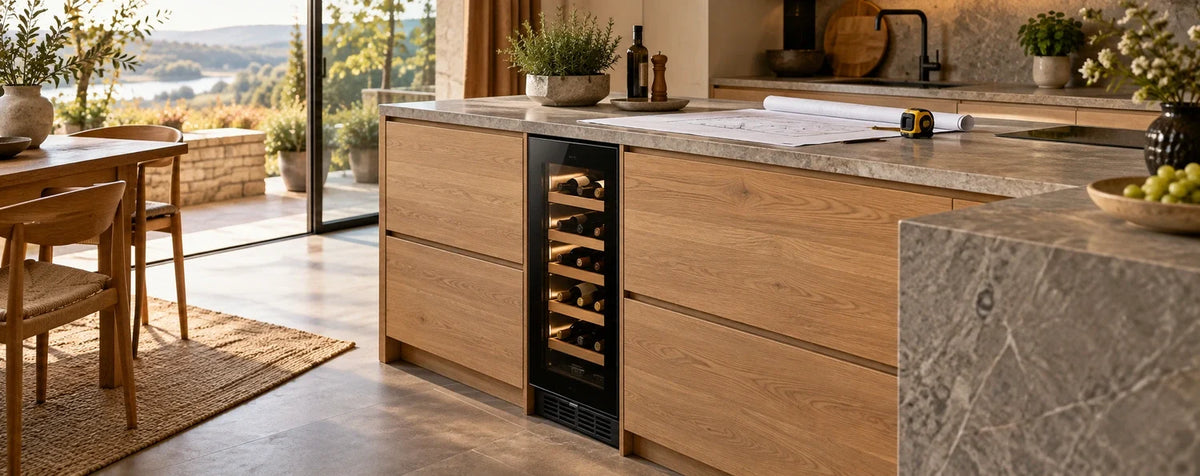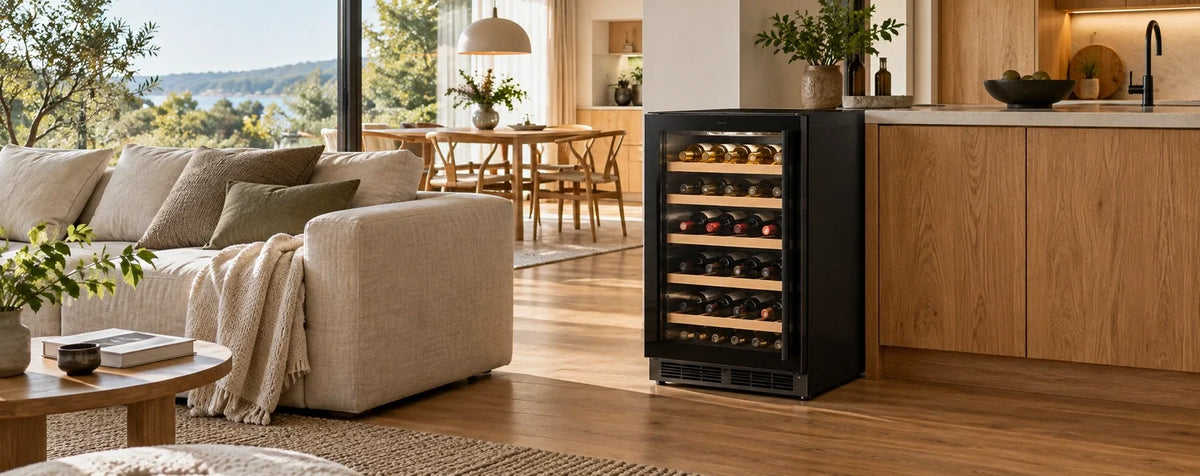
How loud a wine cooler is depends on its model and installation. Compare the stated dB(A) value and noise emission class on the energy label. These describe appliance emissions under specified test conditions; they do not guarantee a particular sound level at your sofa or silent operation.
Wine needs a suitable storage place, and your home should remain a place to relax. Noise therefore belongs in the buying decision, especially in an open-plan kitchen. A lower value helps comparison, but the room, operating phases and fitting also influence how you perceive the cooler in everyday use.
Where can I find a wine cooler’s noise rating?
Look at the current energy label and product information sheet for the exact model reference. On appliances carrying this information, they state airborne noise emissions in dB(A) and a noise emission class from A to D. The energy efficiency class from A to G is a separate rating.
Compare the same measurement. Marketing descriptions such as “quiet”, a mode called Silent and a number from a phone measurement are not equivalent alternatives to the declared noise emission. If figures differ, have the current information sheet checked for the full reference.
Understanding dB(A): emissions and sound at your seat
The EU energy label’s noise figure is an A-weighted sound power level referenced to 1 pW. In simple terms, it describes sound power emitted by the appliance. A measurement at a particular distance in your living room is instead a sound pressure level. The two numbers cannot simply be compared directly.
The A indicates a frequency weighting related to human hearing sensitivity. Decibels use a logarithmic scale, so a difference of a few dB is not the same difference expressed as a percentage. For buying purposes, start with this: under comparable measurement conditions, the lower emission rating means less emitted sound power.
Whether you find an appliance pleasant also depends on tonal character, background sounds and operating duration. Steady humming and a noticeable start-up can stand out differently despite similar ratings. Fixed comparisons with whispering or a library are therefore not reliable promises for your kitchen.
Noise emission classes A to D
| Class | Airborne noise emission in the EU classification |
|---|---|
| A | Below 30 dB(A). |
| B | From 30 to below 36 dB(A). |
| C | From 36 to below 42 dB(A). |
| D | 42 dB(A) or above. |
These thresholds come from the EU energy-label classification for refrigerating appliances. They classify emissions rather than personal perception. A 35 dB(A) appliance falls in class B, while one rated 36 dB(A) falls in class C. Moving between classes does not mean the sound changes abruptly.
Specific examples from our range
| Model | Noise figure in product information | Classification range |
|---|---|---|
| mQuvée WineKeeper Exclusive 25D Panel Ready Push-Pull | 35 dB | Within the class B range. |
| mQuvée WineCave 780 60D Panel Ready | 36 dB | Within the class C range. |
| Cavin Arctic Collection 15S Fullglass Black | 39 dB | Within the class C range. |
These examples illustrate differences between individual references, not a ranking by size, brand or price. Check the current label before ordering and consider your installation. A low noise figure establishes neither built-in approval nor a particular bottle capacity.
Which operating sounds can be normal?
Compressor and fans
Compressor appliances may produce humming and changes during start-up or different operating phases. Fans move air inside the cabinet or help release heat. A fan-assisted appliance can therefore produce airflow noise even when the compressor is less noticeable.
Refrigerant and material movement
Gentle flowing or gurgling sounds can come from the refrigerant circuit. Brief cracking associated with temperature-related material movement can also occur. The manual explains which sounds are described as normal for your model; a sound alone does not establish a reliable fault diagnosis.
After loading or in a warm room
Adding many bottles, opening the door frequently or higher room temperatures can increase cooling demand. Longer operating periods do not automatically mean a fault. Still check that the room suits the climate class, the door closes and required ventilation is unobstructed.
Why a cooler may stand out more in an open-plan kitchen
A quiet living space offers less background sound to mask operation. Distance from your seat, hard surfaces and room design influence what you hear. An open connection between kitchen and sofa cannot be compensated for by a favourable dB rating alone.
If you are sensitive to recurring tones, choose the location carefully. A position beside your favourite reading chair is different from a separate kitchen. Our article on choosing a location for your wine cooler provides further planning guidance.
Infographic: assess the rating and installation together

Installation checks that can prevent additional noise
- Position the appliance level and stable as instructed.
- Maintain required ventilation and clearances.
- Avoid contact with furniture parts unless specified in the installation plan.
- Arrange shelves and bottles to prevent unintended rattling.
- Check the door seal and unobstructed closing.
- Have the plinth and mounting completed correctly.
Poor alignment or vibrating furniture parts can affect perceived sound. Do not add insulation that blocks airflow or unapproved pads that impair stability or fitting. For appliances in an opening, our comparison of undercounter and integrated installation helps establish the appropriate format.
Ventilation and noise also relate to operating workload. Compare annual electricity use too; a noise mode does not replace suitable installation.
When should you contact customer service?
Have persistent new rattling, scraping or strong vibrations checked, especially if accompanied by temperature problems or an error message. Record timing, operating conditions and the full model reference. A short recording can support your description but does not replace technical assessment.
Start with the accessible checks in the manual. Do not open casing sections or modify the refrigerant circuit yourself. Our contact page helps you pass your observations and appliance details to the service team.
Frequently asked questions about wine cooler noise
Does 35 dB mean silent?
No. A lower emission rating means less emitted sound power under the test conditions. The appliance can still be audible in a quiet room.
Is 40 dB suitable for an open-plan kitchen?
That depends on location, room and personal sensitivity. The value falls within noise emission class C; it does not promise that you will not hear operation.
Can I verify the energy label using my smartphone?
A phone app at your seat measures under different conditions and often with limited accuracy. Its result is not directly comparable with the label’s sound power rating.
Are small wine coolers always quieter?
No. Compare the exact reference and declared noise value. Size alone is not a reliable criterion.
Does every model have a Silent mode?
No. Check the specifications and manual. An available mode also does not guarantee silence or every desired temperature distribution.
Does an audible fan indicate a fault?
Not automatically. Air movement is part of normal operation on many appliances. New, persistent or unusual sounds should be checked as instructed and reported to service where necessary.
Wine storage that fits your home
Explore mQuvée wine coolers or compact models and compare noise, size and installation together. Our personal advice service can help select a model for your living space.